Brazil: New Oil Drive Impacts
Oil-rich Brazil!
Despite his commitment to the environment, President
Lula wants to revive Brazil's oil industry for two reasons: 1) to increase
important federal revenues for his social programs, 2) to ensure Brazil's
energy security, recognizing that the energy transition will take time.
Brazil has become a major player in the oil market and
is expected to consolidate production at 4 million barrels per day. This is not
sudden. It is the product of decades of sustained oil policy, even under
Bolsonaro or Temer, of exploration and development that respects the plans of
Petrobras, its partners, and a stable legal framework. As production in the
pre-salt grows, Brazil is likely to use the time to explore opportunities to
diversify its export market beyond its traditional buyers. Brazil is also
taking advantage of the decline in Venezuelan, Mexican and Argentine oil due to
misguided policies and poor management. While looking for new markets, possibly
in regions such as Asia, Brazil understands the importance of maintaining solid
relations with its traditional buyers such as the United States. That is why
the United States is not concerned about Brazil's membership in OPEC+. This
dual approach ensures a balanced oil export strategy, serving established
markets while expanding into new ones to optimize its growing production
capacity.
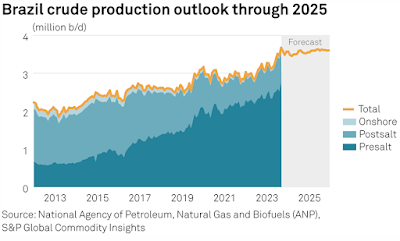
What is operational?
In late December, Petrobras brought the Sepetiba FPSO on stream in the Mero pre-salt field in the Santos Basin, with another FPSO planned for the field later this year. The new unit will add an additional 180,000 b/d of oil and 424 mmscfd of gas capacity. In 2024, the Mero pre-salt field stands out as the main project responsible for boosting domestic production, in particular the start-up of the Sepetiba FPSO and the commissioning of the third Mero FPSO. After 2024, production growth will be driven by the installation of new FPSOs on assets already producing in the pre-salt, such as Búzios and Mero. In the next two years, production is expected to remain relatively stable as the planned FPSOs gradually come on stream.
What's next for Brazilian oil?
OPEC forecasts that Brazil will add about 120,000 b/d
in 2024, averaging 4.2 million b/d for the year, compared with 400,000 b/d of
additions and 4.1 million b/d in 2023. Crude oil growth is expected to come
mainly from the Mero, Búzios and, to a lesser extent, Tupi, Peregrino and Itapu
fields. In 2025, Petrobras plans to add five new pre-salt units in the Santos
and Campos basins. Between 2024 and 2028, the state-owned company will add
another six FPSOs in the giant Búzios field, bringing the company's total to
14. Petrobras has earmarked 73% of its planned capital expenditure for 2024-28
for exploration and production.
Brazil is always looking to expand its upstream
supply. On December 13, Brazil's oil,and gas agency, ANP, celebrated the fourth
cycle of its open acreage under concession regime and the second cycle of its
open acreage in production sharing (OAPS) regime. Of particular interest was
the Pelotas Basin. In this basin, 44 blocks out of a total of 192 exploration
blocks were awarded in the fourth cycle. Pelotas had not received any bids
since the sixth bidding round.
The government hopes that the geology of the Pelotas
Basin is similar to that of the Namibian Basin on the other side of the
Atlantic. The South American plate broke away from Africa during the Cretaceous
period. Several major oil discoveries have been made in Namibia in recent
years. The oil production potential of Brazil's Pelotas Basin remains
speculative until further exploration drilling and appraisal is completed.
Typically, the transition from discovery to development in such basins can take
8 to 10 years, indicating that this is a long-term prospect rather than a
short-term solution. Production has now gone through this period first.
Meanwhile, also in the second cycle of the OAPS regime, BP acquired the
Tupinamba block in the Santos Basin, but no bids were received for the
remaining four blocks.
The likelihood of additional bid rounds in 2024
depends on industry interest. Brazil's "standing offer" system, which
allows interested parties to nominate areas for exploration, provides a
flexible framework for initiating bid rounds based on market interest and
potential. Within this framework, Brazil's NOC has also earmarked 41.5% of its
2024-28 exploration budget for the Equatorial Margin, which covers the mouth of
the Amazon. Oil exploration is controversial in the region, but the government
says the geology could prove similar to that of Suriname and Guyana. The
state-owned company intends to test the region's oil potential by drilling at
least 16 wells and will continue to search.

Geopolitical implications
Brazil boasts annual production growth of nearly 20%
through December and has ambitions to become the fourth largest oil producer by
2030. Increasing domestic production is at the heart of Brazil's recent
admission to OPEC+. The pact recognizes the country's growing influence,
particularly as pre-salt oil increases, while the Brazilian government also
wants to build closer economic and political ties with the world's largest
exporters. OPEC+ membership would allow Brazil to forge closer ties with other MENA
regional powers, particularly Saudi Arabia, OPEC's most influential member.
Petrobras intends to make investments for development
in several countries, such as Venezuela (if Maduro fixes or optimizes its oil
industry), Colombia, Bolivia and Argentina, although the details and concrete
plans for these projects have yet to be determined. For now, a lot of good will has been
generated, but it remains to be seen how it will be translated into concrete
actions. It should be remembered that "Brazilians are good talkers",
although it is certain that as long as the PT remains in power, there will be
ample opportunities for investment. A conservative candidate who clashes with
the rest of the government would be another matter. The United States is not
concerned about this issue because the more production the better, and OPEC+ is
the one that always does the hard work necessary to maintain competitive prices
for American crude. In other words, OPEC+ is not so cruel with the price
because it is in the interest of a growing global economy and at the same time
helps maintain competitive prices for more expensive crudes like U.S. crude. It's a
win-win.


Comments
Post a Comment