Posts

Showing posts with the label Energy

Energy: one reason to defend Mercosur

Image
  Brazil has played a crucial role in avoiding a widespread blackout in Argentina in February 2025. Brazilian electricity exports to its neighbour averaged 700 MW, an increase of 121% compared to the same month last year and 99% more than in January. This volume, the highest since August 2024, is estimated to cover around 5% of Argentina's national consumption. The need for this energy assistance arises from a combination of factors in Argentina. The country faced record electricity consumption in February due to intense heat waves, which have caused extreme weather effects such as heavy rains and floods, especially in Buenos Aires. These events have highlighted the fragility of Argentina's electricity system, which suffers from chronic problems such as lack of investment, deteriorating infrastructure and dependence on energy imports. Argentina's energy crisis is part of a broader context of economic and political challenges. Javier Milei's government has implemente...

Latin America: conflict and energy

Image
  Latin America is affected by remote conflicts. The region also has its own conflicts, but they are not as affected by this as conflicts in regions that sell or consume raw materials. These are the Middle East and Asia. Verisk Maplecroft says that conflict-affected areas have grown by 65% since 2021. They now cover 4.6% of the world's land, up from 2.8% three years ago. That's almost twice the size of India. The upsurge in conflict is having a significant impact on people, migration, geopolitics, the economy and international trade. More people are dying in violence. By the end of the year, there will be more than 200,000 deaths from conflict, which is 29% more than in 2021. The Middle East and Ukraine are the most intense war zones. Both could get worse. Twenty-seven countries, including Ecuador, Colombia, India, Indonesia and Thailand, have seen a big rise in risk since 2021. But sub-Saharan Africa has seen more conflict than any other region. The Indo-Pacific region is ...

Argentina and the evolution of South America's gas geopolitics

Image
  According to Bolivia's state-owned oil company YPFB, Bolivia's natural gas exports to Argentina have ceased following almost two decades of trade. This is due to a decline in production in Bolivia and Argentina's increasing status as a fuel exporter. This marks the end of the Kirchnerist and Evista (Evo Morales) era, as well as the true nature of the evolution of Bolivian fields and disinvestment in exploration and development in the Andean country. It is important to recall that during the Kirchners' initial period of statist rule, significant damage was done to Argentina's gas capabilities in the areas of exploration, development and transportation. Following the expropriation of foreign private companies exploring and establishing production capacities, Bolivia was able to capitalise on the results of their work in the gas industry. The Bolivians failed to capitalise on the opportunities presented to them and are now facing challenges. The Argentine turnaroun...

Colombia and Petro's political-energy chaos

Image
  Petro is balancing between trying to negotiate with “Santismo” and a section of some of the parties prone to the corruption of the "mermelada" to gain control of important bodies such as the Procuraduría and thus influence the renewal of the Constitutional Court and other bodies that could be key to his political future, which does not look good surrounded by many corruption scandals, and mobilising his electoral base and related social movements, victimising himself before the alleged existence of a "coup" or an "assassination attempt" (a classic move of Latin American authoritarian rulers). If this were the only problem in Colombia, all would be relatively well, but the situation is not good and serious crises are still looming with a Petro lost in his political-emotional labyrinth. These crises are: 1) electricity, 2) social conflict that threatens food security, 3) the failure of total peace. On the energy front, Colombia faces the possibility of e...

Economic effects of the drought in Brazil

Image
  Brazil is facing the worst drought ever recorded since the beginning of the current historical series in 1950. According to an index that measures the amount of rainwater and plant evapotranspiration, the current situation exceeds the droughts of 1998 and 2015/2016. Data from Cemaden (National Center for Natural Disaster Monitoring and Alerts), cited by the Brazilian press, shows that this year's drought problem extends to five million square kilometers, 58% of the national territory and 500,000 more than in 2015. Since Cemadem's data goes back to 1950, some of the country's most severe droughts are not included in the comparison, such as the one recorded in the late 1870s that left hundreds of thousands of dead. Although the 2024 data is only from April, low precipitation and stress on vegetation, a fire risk factor, show that Brazil is on track for increasingly drier years. The impact was already felt in agriculture a few months ago and is still being felt as it b...

When Other Eurasian Powers Become Interested in Latin America

Image
  Various Eurasian powers are deploying their simplest strategies to connect with Latin America's mining and agri-food potential. There is Turkey, Qatar, the United Arab Emirates, Saudi Arabia, Iran, but the one that stands out most now is India. India has been actively engaged in talks with countries in Latin America (including Africa) to secure critical mineral blocks essential for clean energy technologies (electric vehicles, wind turbines, and power grids), especially lithium, while continuing to pursue oil for energy security reasons. In January, India signed a $24 million agreement for lithium exploration in Argentina. This is part of a broader strategy in which India aims to acquire mineral blocks on a government-to-government or priority basis from resource-rich countries in these regions. In any case, India's Ministry of Mines is also prioritizing the exploration of critical minerals domestically. It recently auctioned its first lithium block in Chhattisgarh, and m...

Brazil and its decarbonization

Image
  Brazil still has no deadline for phasing out fossil fuels, although at the end of January, Minister of Mines and Energy Alexandre Silveira signed a cooperation agreement with the International Energy Agency to accelerate the country's energy transition. Brazil's climate target (known as NDC, an acronym for Nationally Determined Contribution) outlines emission reduction scenarios for the entire economy, without specifying deadlines for specific sectors. The federal government is developing a new plan, but it is not expected to be implemented until 2025. Brazilian ESG observers are clear that the country's policy is not one of transition and that, at least until 2030, the expansion of hydrocarbon production and consumption will continue to be a priority. Indeed, the new PAC demonstrates this imbalance. Most of the R$ 565.4 billion foreseen in the program's Transition and Energy Security Axis goes to dirty fuels: 64% of the total will go to the oil and gas industry, ...

Latin America at a crossroads

Image
  Latin America faces several crossroads in the coming years. The most important one is Trump's possible victory, with implications for many Pink Tide governments, especially Brazil, Mexico and Colombia. The other has to do with the management of its relations with China in the midst of maneuvers to circumvent American restrictions on global industry, including certain strategic sectors. China will insist on circumventing American restrictions by using its Asian neighborhood and the environment of its customers in the West. With Trump, it may come to a point where the magnifying glass on Latin American supply chains will be very large. In the midst of all this, Europe looks out of place, or at least somewhat confused and indecisive. There is another crossroads that is much more regional, though with global implications, and that has to do with the impact of insecurity on the functioning of economies and democratic systems. There is evidence of the use of criminal or irregular...

Colombia: Energy insecurity on the horizon

Image
  Petro is about to plunge Colombia into a scenario of energy insecurity and the impact on the economy will be terrible. They already have disinvestment problems upstream and downstream, but what Petro is proposing as an energy policy, especially in hydrocarbons, will leave Colombia and its economy at the mercy of a high energy dependence from abroad. The Situation Colombia's economy is heavily dependent on hydrocarbon revenues. Oil and gas exports now account for about 10% of the country's GDP and 20% of its exports. If Petro takes on these numbers, he should leave his sustainability theme for speeches and let Colombia keep exploring (as long as the guerrillas allow, of course). Colombia's next presidential election is scheduled for May 31, 2026. Much could change in the intervening two years. It is possible that economic pressures and waning public support could force a rethink of energy policy or even cause damage, given the speed with which reserves could be depleted or...

Brazil: New Oil Drive Impacts

Image
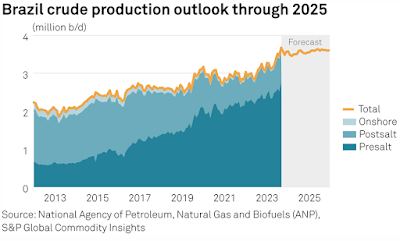
Oil-rich Brazil! Despite his commitment to the environment, President Lula wants to revive Brazil's oil industry for two reasons: 1) to increase important federal revenues for his social programs, 2) to ensure Brazil's energy security, recognizing that the energy transition will take time. Brazil has become a major player in the oil market and is expected to consolidate production at 4 million barrels per day. This is not sudden. It is the product of decades of sustained oil policy, even under Bolsonaro or Temer, of exploration and development that respects the plans of Petrobras, its partners, and a stable legal framework. As production in the pre-salt grows, Brazil is likely to use the time to explore opportunities to diversify its export market beyond its traditional buyers. Brazil is also taking advantage of the decline in Venezuelan, Mexican and Argentine oil due to misguided policies and poor management. While looking for new markets, possibly in regions such as Asia,...